

Error Handling
Learn about error handling in the Micronaut framework.
On this guide
In this section
Getting Started
In this guide, we will create a Micronaut application written in Groovy.
What you will need
To complete this guide, you will need the following:
-
Some time on your hands
-
A decent text editor or IDE (e.g. IntelliJ IDEA)
-
JDK 21 or greater installed with
JAVA_HOMEconfigured appropriately
Solution
We recommend that you follow the instructions in the next sections and create the application step by step. However, you can go right to the completed example.
-
Download and unzip the source
Writing the Application
Create an application using the Micronaut Command Line Interface or with Micronaut Launch.
mn create-app example.micronaut.micronautguide --build=maven --lang=groovy|
Note
|
If you don’t specify the --build argument, Gradle with the Kotlin DSL is used as the build tool. If you don’t specify the --lang argument, Java is used as the language.If you don’t specify the --test argument, JUnit is used for Java and Kotlin, and Spock is used for Groovy.
|
The previous command creates a Micronaut application with the default package example.micronaut in a directory named micronautguide.
Global @Error
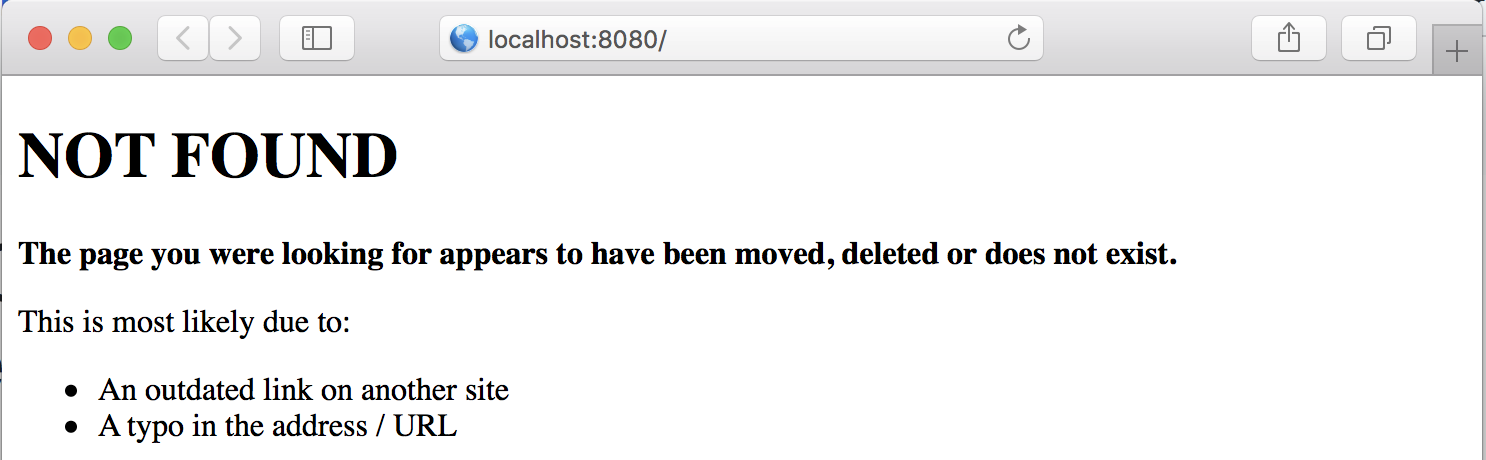
We want to display a custom Not Found page when the user attempts to access a URI that has no defined routes.
The views module provides support for view rendering on the server side and does so by rendering views on the I/O thread pool in order to avoid blocking the Netty event loop.
To use the view rendering features described in this section, add the following dependency on your classpath. Add the following dependency to your build file:
<dependency>
    <groupId>io.micronaut.views</groupId>
    <artifactId>micronaut-views-velocity</artifactId>
    <scope>compile</scope>
</dependency>
The Micronaut framework ships out-of-the-box with support for Apache Velocity, Thymeleaf or Handlebars. In this guide, we use Apache Velocity.
Create a notFound.vm view:
<!DOCTYPE html>
<html>
<head>
    <meta charset="UTF-8">
    <title>Not Found</title>
</head>
<body>
<h1>NOT FOUND</h1>

<p><b>The page you were looking for appears to have been moved, deleted or does not exist.</b></p>

<p>This is most likely due to:</p>

<ul>
    <li>An outdated link on another site</li>
    <li>A typo in the address / URL</li>
</ul>
</body>
</html>
Create a NotFoundController:
Local @Error
Micronaut validation is built on the standard framework – JSR 380, also known as Bean Validation 2.0. Micronaut Validation has built-in support for validation of beans that are annotated with jakarta.validation annotations.
To use Micronaut Validation, you need the following dependencies:
<dependency>
    <groupId>io.micronaut.validation</groupId>
    <artifactId>micronaut-validation-processor</artifactId>
    <scope>compile</scope>
</dependency>
<dependency>
    <groupId>io.micronaut.validation</groupId>
    <artifactId>micronaut-validation</artifactId>
    <scope>compile</scope>
</dependency>
Alternatively, you can use Micronaut Hibernate Validator, which uses Hibernate Validator; a reference implementation of the validation API.
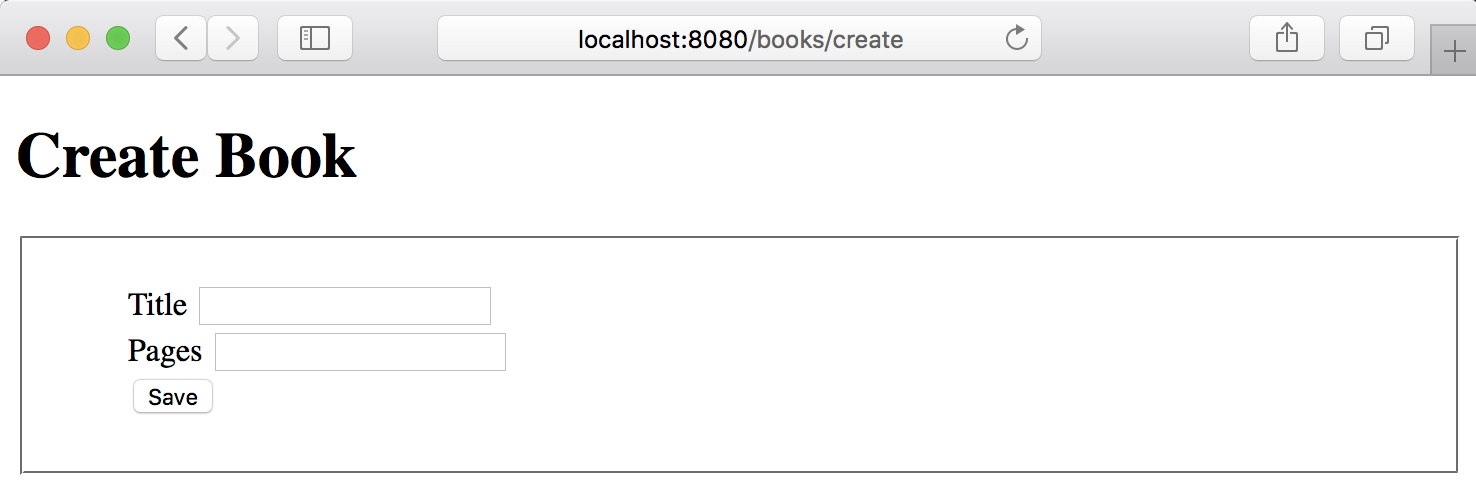
Then create a view to display a form:
<!DOCTYPE html>
<html>
<head>
    <meta charset="UTF-8">
    <title>Create Book</title>
    <style type="text/css">
        form fieldset li {
            list-style-type: none;
        }
        #errors span { color: red; }
    </style>
</head>
<body>
<h1>Create Book</h1>
<form action="/books/save" method="post">
    <fieldset>
        <ol>
            <li>
                <label for="title">Title</label>
                <input type="text" id="title" name="title" value="$title"/>
            </li>
            <li>
                <label for="pages">Pages</label>
                <input type="text" id="pages" name="pages" value="$pages"/>
            </li>
            <li>
                <input type="submit" value="Save"/>
            </li>
        </ol>
    </fieldset>
</form>
#if( $errors )
    <ul id="errors">
        #foreach( $error in $errors )
            <li><span>$error</span></li>
        #end
    </ul>
#end
</body>
</html>
To use the serialization features described in this section, add the following dependency to your build file:
<dependency>
    <groupId>io.micronaut.serde</groupId>
    <artifactId>micronaut-serde-jackson</artifactId>
    <scope>compile</scope>
</dependency>
Create a controller to map the form submission:
Create the POJO encapsulating the submission:
When the form submission fails, we want to display the errors in the UI as the next image illustrates:
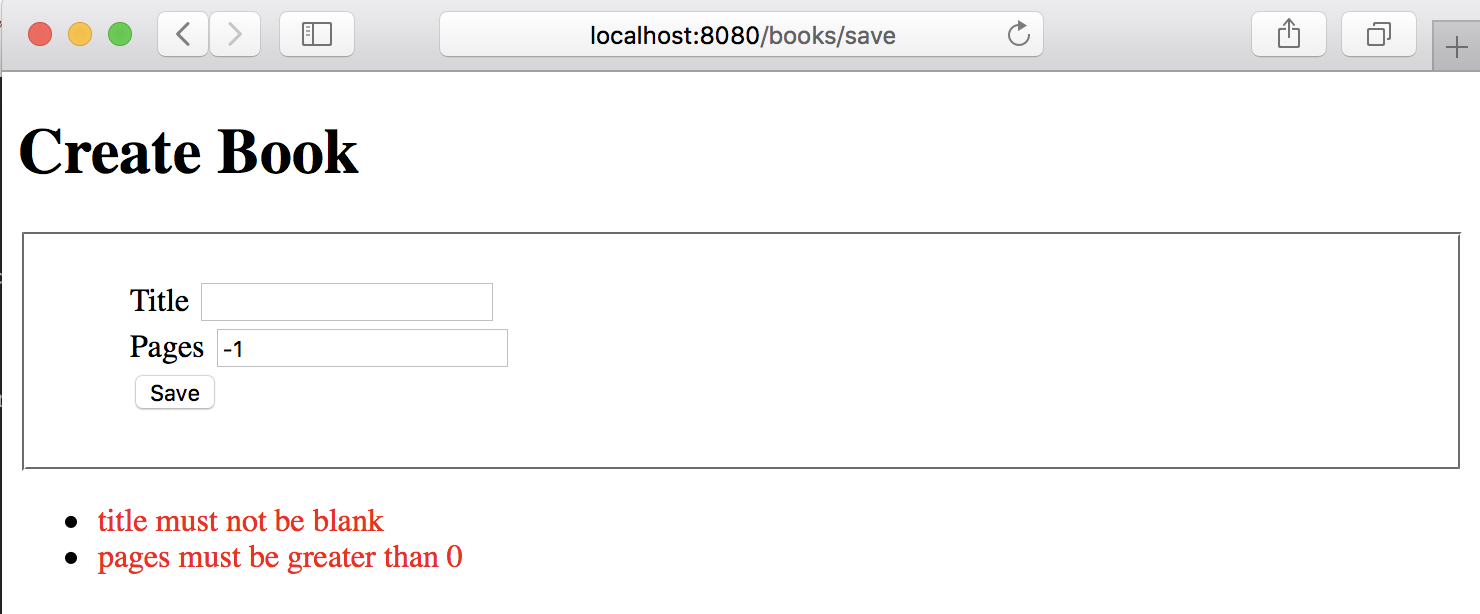
An easy way to achieve it is to capture the jakarta.validation.ConstraintViolationException exception in a local @Error handler. Modify BookController.java:
Create a jakarta.inject.Singleton to encapsulate the generation of a list of messages from a Set of ConstraintViolation:
imports
package example.micronaut

import groovy.transform.CompileStatic
import jakarta.inject.Singleton

import jakarta.validation.ConstraintViolation
import jakarta.validation.Path
@CompileStatic
@Singleton
class MessageSource {
List<String> violationsMessages(Set<ConstraintViolation<?>> violations) {
violations.collect {violationMessage(it) }
}
private String violationMessage(ConstraintViolation violation) {
StringBuilder sb = new StringBuilder()
Path.Node lastNode = lastNode(violation.propertyPath)
if (lastNode) {
sb << lastNode.name << ' '
}
sb << violation.message
sb
}
private static Path.Node lastNode(Path path) {
Path.Node lastNode = null
for (final Path.Node node : path) {
lastNode = node
}
return lastNode
}
}ExceptionHandler
Another mechanism to handle a global exception is to use an ExceptionHandler.
Modify the controller and add a method to throw an exception:
imports
package example.micronaut

import groovy.transform.CompileStatic
@CompileStatic
class OutOfStockException extends RuntimeException {
}Implement an ExceptionHandler, a generic hook for handling exceptions that occur during the execution of an HTTP request.
Next Steps
Explore more features with Micronaut Guides.
License
|
Note
|
All guides are released with an Apache License 2.0 for the code and a Creative Commons Attribution 4.0 license for the writing and media (images). |